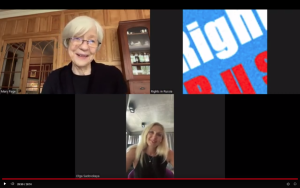
Podcast Then & Now #43: Teresa Cherfas in conversation with Linor Goralik
1 October 2026
by Teresa Cherfas
Welcome to the 43rd edition of the Russian-language podcast Then & Now with me, Teresa Cherfas
Linor Goralik
Today our guest is the poet, writer, artist and activist Linor Goralik.
Linor was born into a Jewish family in 1975 in Dnipropetrovsk. In 1989 her family emigrated to Israel.
From 2000 to 2014, Linor lived and worked in Moscow. After that, she divided her time between Israel and Russia until November 2021.
In March 2022, just two weeks after the start of the so-called ‘Special Military Operation’, Linor Goralik travelled to Tbilisi, Yerevan and Istanbul before returning to Israel – to Tel Aviv and Jerusalem – documenting the mass exodus of people from Russia triggered by the full-scale invasion of Ukraine.
She subsequently presented these people’s testimonies in a bilingual publication by the Tamizdat Project entitled Exodus-22. The book was published last year.
‘In March 2022, after the full-scale invasion of Russian forces into Ukraine, I went on a trip that took me from Israel to Tbilisi to Yerevan to Istanbul and back to Israel. I hoped to take notes on this ‘Exodus-22’ – that is, to create a record of people leaving Russia over the course of these weeks. This experience was incredibly important for me, and I am endlessly grateful to the people who met with me, spoke with me, and helped me work with this material. I should add that all of the Ns in these notes are different people, and the order of the notes for each location is roughly chronological’
Do you remember your initial reaction when you heard the news about Russia’s full-scale invasion of Ukraine?
What prompted you to set off on this journey? Why was it important to you? You mentioned somewhere that it was for love… A love story… with whom, or with what?
You started in Tbilisi. Tell us what you found there and how you began working with your interviewees. Did you record them? How did the process develop?
How did they feel in Georgia? What did immigrants from Russia encounter there?
After Tbilisi, you travelled to Yerevan. Did you notice a difference in the way Russian immigrants were received there?
You decided to refer to all your interviewees, without exception, as ‘N’. Why?
There’s a very palpable sense of disorientation, a kind of surrealism, and a general sense of bewilderment in your interviewees’ conversations, regardless of where they are. Is this the experience of refugees everywhere or are there specific characteristics that are particular to Russians?
Did you observe any similarities in your respondents’ reflections whilst carrying out your research? In their emotions? In their feelings when they realised the scale of their decision to leave Russia?
Many of those you spoke to are parents. What, in your view, lies in store for their children’s generation? Will there be a rift with their parents, with their values, their memories?
You yourself emigrated to Israel with your parents at a young age. Did you identify with their situation when you listened to their answers to your questions? Was your own experience an important tool for you in understanding their situation?
Among the new immigrants from Russia, is there a noticeable difference in attitudes between Jews and Russians?
Russians who left Russia after February 2022 are often accused of having an imperialist mindset. Is this justified, in your view? Was this at all evident in your conversations?
Has their understanding of what it means to be Russian changed?
Did you sense any hope for Russia’s future, a future that your respondents could believe in?
The word ‘mosaic’ is often used to describe your book. Did you deliberately set out to present the experience of the new wave of Russian emigration in this way? What do you think this approach adds to our understanding?
Is there a connection between your work and, say, the work of Svetlana Alexievich or Teffi – both of whom, it could be said, collected testimonies from living witnesses to historical events?
In his review of Exodus-22, Ilya Utekhin wrote: ‘Diary entries preserve the contours of a moment before it becomes frozen in narrative, before a feeling is transformed into theory.’ Could you name some “moments” that surprised you in your conversations with your various ‘N’s?
We use cookies to improve your experience on our site. By using our site, you consent to cookies.
Cookie Preferences
Manage your cookie preferences below:
Essential cookies enable basic functions and are necessary for the proper function of the website.
Name
Description
Duration
_cfuvid
Cloudflare sets this cookie to track users across sessions to optimize user experience by maintaining session consistency and providing personalized services
Session
Cookie Preferences
This cookie is used to store the user's cookie consent preferences.
30 days
These cookies are needed for adding comments on this website.
Name
Description
Duration
comment_author
Used to track the user across multiple sessions.
Session
comment_author_email
Used to track the user across multiple sessions.
Session
comment_author_url
Used to track the user across multiple sessions.
Session
These cookies are used for managing login functionality on this website.