

18 – 20 March 2026
by Anna Karetnikova
Source: Facebook
18 March 2026
I’ve lost count already… There was a person, he wrote something on his Odnoklassniki page, and he got six and a half years under the antiwar article, for fake news. (The sentence was handed down by Judge Yuliya Terekhova in Lyubertsy.) He was ill and asked for help. Then he died. And you think, Well, we’re all mortal, yes, he died, oh well… Maybe he would have died anyway: his time had come. But no. He died in captivity. And he didn’t send himself there. And there are people responsible for all this. None of this is all right. And we should not, must not get used to this.
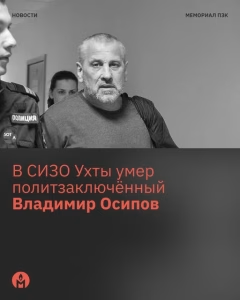
Vladimir was held in a Moscow Oblast remand centre and during the first session of the court of appeals complained several times about the state of his health. The court’s attention had been drawn to his health problems at first instance as well. Instead of sending Vladimir for appropriate treatment he was sent to the Ukhta remand centre. That is where his death was reported today’, writes the human rights project Prison Attorney.
Vladimir Osipov was 56 years old. Before his arrest he lived in Dzerzhinsk outside Moscow, and he had been deprived of his liberty since November 2024. On 10 November 2025, the man was sentenced to six and a half years of general regime penal colony. Despite the fact that his sentence had not yet gone into effect, Osipov was transported to another region. Osipov suffered from hypertenesion and kidney stones. His condition deteriorated due to stress and a lack of proper treatment in the remand centre. At nearly every hearing they had to call an ambulance for the man—he was given pills but was often refused hospitalization.
Osipov complained of a bad headache and feeling unwell and asked for a postponement of the hearing or his final statement, but the judge refused him and even removed him from the courtroom’, SOTAvision recounts. The court at first instance viewed his complaints of high blood pressure as waiving his final statement, RusNews reminds us’.
– Political Prisoners. Memorial, 18 March 2026
Source: Facebook
20 March 2026
Everyone seems to expect something new from the FSIN [Federal Penitentiary Service] so much that any news from there tries to become a sensation. Here’s something from a Kommersant report about how a new law is being readied about more prisoners being able to be left to work in the remand centre, and people drew this whole conclusion about how the system is preparing for super-penal-colonies (which, it’s true, have yet to be built and it’s not a fact they ever will). But actually they’re talking about a total of 300 prisoners and a wage fund being created of 100 million rubles, of which 25,000 is going to be allotted for wages (most of which, of course, they’ll take away, unfortunately).
More than likely, it’s simply a matter of having a pretty reason for correcting the staffing plan, in order to bring in additional personnel units and at the same time obtain the right to some kind of minor manufacturing. For example, say there’s a hairdresser in the women’s remand centre, which is important for the prisoners. But there is no hairdresser unit. That means the hairdresser has to be listed as a laundress. Should any commission come and not see her at a washing machine, they would punish everyone. Or there’s someone who knows how to make really classy objects to sell. But he has to be listed as a cleaner, which is, of course, awkward.
Strange but true: ‘The Justice Ministry recognizes that the innovation will lead to an increase in the number of guards in pre-trial detention centres. The suggestion is to solve this problem at the expense of redistributing employees from institutions eliminated from the FSIN [Federal Penitentiary Service] system’. It seems to me that if three dozen remand centres want to increase the staff of their remand centre by 10 people, that is not going to lead to any grandiose redistribution. In my opinion, all this is about is that remand centres want to earn a little money, and to do that they have to make a slight change in a provision of the law.
True, the text in Kommersant is odd, saying, convicts are going to ‘live in unlocked common cells, have the right to a daily two-hour walk, and have individual bunks, bedding, and clothing’. It’s good, of course, that they won’t be naked and can even sleep on beds. A two-hour walk in a prison cell is hardly going to bring them pleasure, but it does have its pluses, naturally.
In general, what I wanted to say is not about repressions. Unfortunately, nearly everything else is.
Source: Facebook
Translated by Marian Schwartz


